Showing posts with label book. Show all posts

Sunday, January 24, 2010

From Zero to $100 Million - A Success Story

Tune in to learn how Jonathan Smith and his father launched their beach erosion barrier business in the early 1990s and ultimately landed a $100 million contract with the port of Abu Dhabi to protect strategic assets for them using their floating fence technology.

Rich Sloan interviews Smith and reveals the long but undeniable road to a whopping success story. Learn how a $5,000 investment in a search-engine-friendly website helped  them land their massive, nine-figure deal. Also learn about how Jonathan leaned heavily on his partnership with his father to endure the low points along the way.

This is a story about sticking to it, but not about making crazy sacrifices. Every step of the way, Jonathan was basing the will to press on on feedback and real potential being indicated by the marketplace.

Want inspiration? This is your podcast!

Learn about the company at www.whisprwave.com.

Podcast

Wave Dispersion Technologies (UDM-Keen Interview Series)


2008-1210 Technical Entrepreneurship Case Studies 20080228

Friday, November 30, 2007

Chiefoptimizer Concepts

  • Backlinks

  • Keywords

  • Competitor Keywords

  • Email Inform / Motivate

  • Message Board Participation

  • Online Reputation

  • Reputation Management

  • Social Networking Keys

  • Blog Search Engines

  • Blog Rolls

  • Groups

  • SEO

  • CPC

  • News Alerts

  • Questions and Answers

Thursday, October 25, 2007

Yahoo! People on the Web - Extreme Pumpkins

My buddy Tom Nardone is at it again. He was the first person I know featured as in the People on the Web section of Yahoo!

Very cool!

Extreme Pumpkins in Yahoo!

Saturday, October 20, 2007

Younger Next Year - Suggested Reading

This book is all about being "Younger Next Year." I have worked really hard over the past two years to lose weight, improve my fitness, eat right and surround myself with community. This book talks about all of the benefits of this lifestyle and reaffirms my lifestyle adjustments and has even further reinforced my resovle to be "Younger Next Year."

Quote about Human Leaders from Everyday Leaderhip

I really liked this excerpt from Dan Mulhern's book "Everyday Leadership," it talks about the humanity involved in leadership. More "leaders" should heed his advice and the world would be a much better place.

The only enduring way to get humans' best stuff is to be fully human ourselves. And being human means sometimes dealing with a stinky diaper. It means facing some of our stinky behaviors, thoughts and feelings -- such as feeling ignored or forgotten or wrong. And it also means we get to face the splendid possibility that we could be much better and happier leaders if we quit doing what we think we should do, what we've always done, what we're comfortable doing, and instead do what our people need us to do.

I am inviting you to consider a more human leadership . . .

This kind of human leadership lets us be the person who can get what our hearts most desire: a connection with other people in which we make each other better and do something together that we could not have done alone, a person not perfect but perfectly alive.


Sunday, September 09, 2007

My Buddy Tom's New Book - "Extreme Pumpkins"

My buddy Tom Nardone's book "Extreme Pumpkins" was recently published by Penguin Group.

I actually helped him carve a few pumpkins for the book last fall. Tom is a total character and we had a great time learning pumpkin carving tricks.

Check it out, great source for info and pictures about carving an awesome pumpkin.


Friday, March 31, 2006

Suggested Reading on Blogging

I just read Naked Conversations on my the plane back from San Diego. I really enjoyed it and feel that it is a must read for anyone who really wants to learn about and understand blogging.

Sunday, March 12, 2006

The Power of the Connected Consumer

The Future of CompetitionThe most basic change has been a shift in the role of the consumer—from isolated to connected, from unaware to informed, from passive to active. The impact of the connected, informed and active consumer is manifest in many ways. Let us examine some of them.

  • Information Access
    With access to unprecedented amounts of information, knowledgeable consumers can make more informed decisions.
  • Global View
    Consumers can also access information on businesses, products, technologies, performance, prices and consumer actions and reactions from around the world. Geographical limits on information still exist, but they are eroding fast, changing the rules of business competition.

  • Networking
    Human beings have a natural desire to coalesce around common interests, needs and experiences. The explosion of the Internet and advances in messaging and telephony—the number of mobile phone users is already over one billion—is fueling this desire, creating an unparalleled ease and openness of communication among consumers. Consequently, "thematic consumer communities," in which individuals share ideas and feelings without regard for geographic or social barriers, are revolutionizing emerging markets and transforming established ones. The power of consumer communities comes from their independence from the company.
  • Experimentation
    Consumers can also use the Internet to experiment with and develop products, especially digital ones. The collective genius of software users the world over has similarly enabled the codevelopment of such popular products as the Apache Web server software and the Linux operating system. The diversity of informed consumers around the world creates a wide base of skills, sophistication and interests that any individual can tap into.
  • Activism
    As people learn, they can better discriminate when making choices; and, as they network, they embolden each other to act and speak out. Consumers increasingly provide unsolicited feedback to companies and to each other.
  • Conclusion
    Companies can no longer act autonomously—designing products, developing production processes, crafting marketing messages and controlling sales channels—with little or no interference from consumers. Consumers now seek to exercise their influence in every part of the business system. Armed with new tools and dissatisfied with available choices, consumers want to interact with firms and thereby cocreate value. The use of interaction as a basis for cocreation is at the crux of our emerging reality.
Full Story

Monday, February 27, 2006

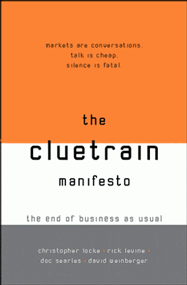
Favorite thoughts from The Cluetrain Manifesto

The Cluetrain ManifestoI picked out some of my favorite theses from The Cluetrain Manifesto.

See below:

  • Hyperlinks subvert hierarchy.
  • As a result, markets are getting smarter, more informed, more organized. Participation in a networked market changes people fundamentally.
  • People in networked markets have figured out that they get far better information and support from one another than from vendors. So much for corporate rhetoric about adding value to commoditized products.
  • There are no secrets. The networked market knows more than companies do about their own products. And whether the news is good or bad, they tell everyone.
  • Companies that assume online markets are the same markets that used to watch their ads on television are kidding themselves.
  • Companies that don't realize their markets are now networked person-to-person, getting smarter as a result and deeply joined in conversation are missing their best opportunity.
  • Companies can now communicate with their markets directly. If they blow it, it could be their last chance.
  • Companies need to lighten up and take themselves less seriously. They need to get a sense of humor.
  • Getting a sense of humor does not mean putting some jokes on the corporate web site. Rather, it requires big values, a little humility, straight talk, and a genuine point of view.
  • Companies need to come down from their Ivory Towers and talk to the people with whom they hope to create relationships.
  • Intranets naturally tend to route around boredom. The best are built bottom-up by engaged individuals cooperating to construct something far more valuable: an intranetworked corporate conversation.
  • While this scares companies witless, they also depend heavily on open intranets to generate and share critical knowledge. They need to resist the urge to "improve" or control these networked conversations.
  • When corporate intranets are not constrained by fear and legalistic rules, the type of conversation they encourage sounds remarkably like the conversation of the networked marketplace.
  • Today, the org chart is hyperlinked, not hierarchical. Respect for hands-on knowledge wins over respect for abstract authority.
  • Smart companies will get out of the way and help the inevitable to happen sooner.
    If you want us to talk to you, tell us something. Make it something interesting for a change.
  • We want you to take 50 million of us as seriously as you take one reporter from The Wall Street Journal.
  • We know some people from your company. They're pretty cool online. Do you have any more like that you're hiding? Can they come out and play?
  • When we have questions we turn to each other for answers. If you didn't have such a tight rein on "your people" maybe they'd be among the people we'd turn to.